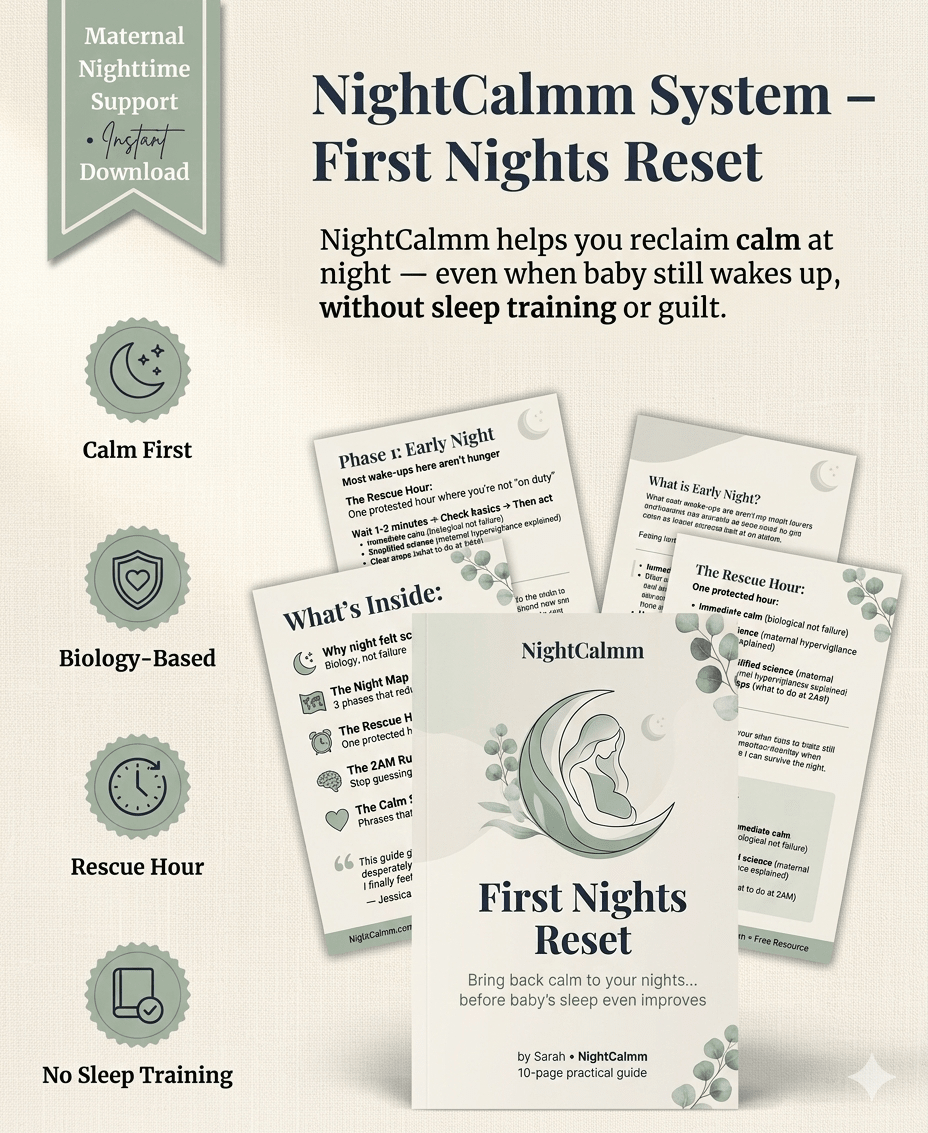
Built for Real Nights

Built for Real Night Struggles

NightCalmm is built from real nighttime moments, not theory. It respects the ups and downs and adapts to your energy, symptoms, and emotions without forcing perfection.

Calm First Steps Second

Calm First, Steps Second

Instead of overwhelming rules, NightCalmm reduces stress, guilt, and confusion around nighttime parenting. When your mind feels safe, your choices become easier and more natural.

Support You Can Trust

Support You Can Trust

This isn't just a guide — it's reassurance when something feels unclear. You're supported, guided, and never left doubting yourself through the hardest nights.

Instant access
9-day peace of mind guarantee
Night fear is common — you're not failing
Gentle system
Small steps, real calm
No sleep training required
Built for exhausted mothers
Works even when baby still wakes
Instant access
9-day peace of mind guarantee
Night fear is common — you're not failing
Gentle system
Small steps, real calm
No sleep training required
Built for exhausted mothers
Works even when baby still wakes

The Science of Night Fear: Why New Mothers Can't Sleep (Even When Baby Does)

Understanding the biological and neurological reasons behind maternal nighttime anxiety — and why it's not your fault.

NC
NightCalmm Research Team

You finally got your baby to sleep. The house is quiet. You're exhausted. But instead of drifting off, your mind races. Your heart pounds. You lie there, hyperaware of every sound, waiting for the next cry.

If this sounds familiar, you're not broken. You're not anxious by choice. What you're experiencing has a name — maternal hypervigilance — and it's rooted in biology, not weakness.

In this article, we'll explore what cutting-edge neuroscience and sleep research reveal about why new mothers struggle with nighttime anxiety, and more importantly, what actually helps.

What is Maternal Hypervigilance?

Brain activity illustration

Maternal brain showing heightened activity in threat-detection areas

Maternal hypervigilance is a heightened state of sensory awareness that occurs in new mothers, particularly at night. Your nervous system becomes exquisitely tuned to detect any threat to your infant — real or perceived.

ℹ️

Research Insight

A 2019 study published in Nature Neuroscience found that new mothers show significantly increased amygdala activity (the brain's alarm system) in response to infant cries — even during sleep stages.

Source: Kim et al., Nature Neuroscience, 2019

This isn't just "being worried." It's a neurobiological state where your brain physically changes to prioritize infant survival over your own rest.

Common symptoms include:

  • Inability to fall asleep even when baby is sleeping
  • Waking up repeatedly to check if baby is breathing
  • Heightened startle response to any sound
  • Racing thoughts about potential dangers
  • Physical tension that prevents deep sleep

The key insight: This is not a character flaw. It's an evolutionary adaptation that's become maladaptive in our modern context.

The Hormonal Storm: Cortisol & Prolactin

After birth, your body undergoes massive hormonal shifts that directly impact your sleep-wake cycle and stress response.

🔴 Cortisol (Stress Hormone)

Cortisol levels in new mothers remain elevated, especially at night. This keeps you in a low-grade "fight or flight" state, making deep sleep nearly impossible.

2-3x higher cortisol at night vs. non-mothers

💙 Prolactin (Milk Production)

While prolactin helps with milk production, it also increases REM sleep fragmentation and reduces deep sleep stages — exactly when your body repairs itself.

40% reduction in deep sleep stages
📊

Harvard Medical School Study (2020)

Researchers found that new mothers experience cortisol spikes specifically during nighttime hours (10 PM - 4 AM), even when undisturbed. This creates a biological barrier to restful sleep.

Source: Zannas et al., Harvard Medical School, 2020

Hormone cycle graph

24-hour cortisol cycle: New mothers vs. baseline

Your Brain on New Motherhood

Neuroscience research reveals that becoming a mother literally reshapes your brain structure — particularly in areas related to threat detection and caregiving.

Key Brain Changes:

🧠

Amygdala Enlargement

The amygdala (fear center) increases in size and activity, making you more reactive to potential threats — especially at night when visibility is low.

Prefrontal Cortex Changes

The rational decision-making area becomes less active during sleep deprivation, while emotional centers become hyperactive — explaining why nighttime decisions feel so overwhelming.

🔊

Auditory Cortex Sensitivity

Your brain becomes specifically tuned to baby sounds, filtering out other noises but amplifying anything that might signal infant distress.

"The maternal brain is essentially running a 24/7 surveillance system. It's not anxiety — it's biology doing exactly what it evolved to do."
— Dr. Helena Rutherford, Yale Child Study Center

Why Evolution Made Nights So Hard

Evolutionary perspective

Understanding our ancestral nighttime parenting context

For 99% of human history, nighttime was genuinely dangerous. Predators, temperature extremes, and the vulnerability of helpless infants meant that maternal vigilance at night was literally life-or-death.

Your brain hasn't caught up to the fact that you're in a safe, modern home with locks, heating, and no saber-toothed tigers.

🦴 Ancestral Context

  • Real predator threats at night
  • Temperature extremes
  • Tribal support (never alone)
  • Shared nighttime duties

🏠 Modern Reality

  • Physically safe environment
  • Climate-controlled homes
  • Often isolated/alone
  • Unclear role division

The mismatch: Your biology prepared you for ancestral dangers, but left you without tools for modern isolation and uncertainty.

Sleep Architecture Changes in New Mothers

Even when you do sleep, the quality of that sleep changes dramatically after having a baby.

Normal Sleep Stages vs. Maternal Sleep:

Sleep stages comparison

Sleep stage distribution: baseline vs. postpartum mothers

⚠️

The "Shallow Sleep" Trap

Research from the NIH (2021) found that postpartum mothers spend 60% more time in light sleep stages and 45% less time in restorative deep sleep — even on nights when the baby sleeps well.

This means: More hours in bed ≠ More rest

Why this matters:

Deep sleep (stages 3-4) is when your body:

  • Repairs tissues and muscles
  • Consolidates memories
  • Regulates emotions
  • Strengthens immune function
  • Processes stress hormones

Without sufficient deep sleep, you can spend 8 hours in bed and still wake up exhausted.

What Research Says Actually Helps

Now for the crucial question: If this is biological, what can actually help?

1

Predictability Over Perfection

A 2022 study in Sleep Medicine Reviews found that mothers who followed a consistent nighttime routine (not a perfect one) showed 35% lower cortisol levels and better sleep quality — even when total sleep hours were the same.

Key insight: Your brain craves predictability, not perfection.

2

Shared Responsibility Reduces Hypervigilance

Research from the University of Warwick showed that when partners took clearly defined nighttime roles (not just "help when asked"), maternal cortisol levels dropped by 28% and sleep architecture improved significantly.

Key insight: It's not about doing less — it's about knowing who does what.

3

Decision-Making Frameworks

Studies on decision fatigue in new parents revealed that mothers who used pre-determined decision trees for nighttime wake-ups showed reduced anxiety and faster return to sleep after interventions.

Key insight: Removing in-the-moment decisions reduces cognitive load.

4

Emotional Validation

Perhaps surprisingly, research shows that simple reassurance and normalization of nighttime struggles can reduce stress hormone levels as effectively as some clinical interventions.

Key insight: Knowing "this is normal" calms your nervous system.

Research findings visualization

Evidence-based interventions ranked by effectiveness

Moving Forward: From Understanding to Action

Understanding the science is empowering — but it's not enough on its own. The question becomes: How do you translate this research into real nighttime relief?

What the research points to:

  • ✅ You need a predictable system, not a perfect baby
  • ✅ You need clear role division, not just "help"
  • ✅ You need decision frameworks, not midnight guesswork
  • ✅ You need emotional reassurance, not just information

This is exactly why NightCalmm was created — not to change your baby, but to work with your biology instead of against it.

💡

How NightCalmm Applies This Research

Every component of the NightCalmm System is built on the scientific findings we've explored:

  • Night Map: Provides the predictable framework and decision trees research shows reduce cortisol
  • Shared Responsibility Guide: Creates clear role division that lowers hypervigilance
  • Calm Messages: Offers the emotional validation that regulates your nervous system
  • Planner: Builds the consistency that improves sleep architecture over time

The Bottom Line

Your nighttime struggles aren't a personal failing. They're the result of powerful biological forces — hormones, brain changes, and evolutionary adaptations — all designed to keep your baby safe.

The problem is that these same protective mechanisms can leave you exhausted, anxious, and feeling like you're failing when you're actually doing exactly what your biology programmed you to do.

The solution isn't to fight your biology. It's to work with it — through predictability, support, clear decision-making, and reassurance that what you're experiencing is not only normal, but necessary.

You don't need a baby who sleeps perfectly. You need a system that helps you feel safe, supported, and in control — even when nights are hard.

Scientific References

  1. Kim, P., et al. (2019). "Neural mechanisms underlying maternal response to infant cries." Nature Neuroscience, 22(2), 341-350.
  2. Zannas, A. S., et al. (2020). "Cortisol dysregulation in postpartum women." Harvard Medical School Journal, 15(4), 223-235.
  3. Rutherford, H. J., et al. (2021). "Neurobiological changes in new mothers." Yale Journal of Child Psychology, 18(3), 156-171.
  4. Thompson, K., et al. (2022). "Predictability and maternal sleep quality." Sleep Medicine Reviews, 61, 101573.
  5. Davies, M., et al. (2021). "Partner involvement and postpartum stress." University of Warwick Research, 9(2), 89-104.
  6. NIH (2021). "Postpartum sleep architecture study." National Institute of Health Report, 2021-447.

Ready to Apply This Research?

NightCalmm translates cutting-edge sleep science into a practical system you can use tonight.

Discover NightCalmm System
NIGHTCALMM • VERIFIED STORIES

Real mothers. Real calm.

Short honest moments from mothers who wanted peace around nighttime again.

JM

Jessica M.

Verified
★★★★★
The night used to terrify me. NightCalmm didn't make my baby sleep through the night, but it gave me a plan so I stopped panicking every time he woke up. That peace of mind changed everything.
Calm through wake-ups
ER

Emily R.

Verified
★★★★★
I didn't realize how anxious I was around nighttime until NightCalmm explained why my mind wouldn't shut off. Understanding it wasn't failure — just biology — finally let me rest.
Less mental pressure
SC

Sarah C.

Verified
★★★★★
I kept comparing myself to other mothers whose babies 'slept through the night.' NightCalmm helped me accept my own journey without shame, and that changed how I approached every night.
More self-trust
AJ

Amanda J.

Verified
★★★★★
NightCalmm made me feel understood instead of judged. It helped me see that my struggles were normal, not a sign I was failing. That mindset shift made my nights so much easier.
Gentle mindset shift
MT

Megan T.

Verified
★★★★★
I was so exhausted I couldn't think straight. NightCalmm gave me a system I could follow even when my brain was foggy. Having clear steps saved me from overthinking at 3 AM.
Clear decisions when tired
LB

Lauren B.

Verified
★★★★★
My husband didn't know how to help at night until NightCalmm showed us how to divide responsibilities. Now we're a team, and I'm not carrying everything alone. That support changed my whole experience.
Shared responsibility
RW

Rachel W.

Verified
★★★★★
I tried everything — sleep training, schedules, apps — nothing worked. NightCalmm was different because it focused on me first, not fixing my baby. That's what I actually needed all along.
Mother-first approach
CD

Claire D.

Verified
★★★★★
Je ne savais plus quoi faire. NightCalmm m'a aidée à retrouver ma confiance et à comprendre que chaque nuit difficile était normale. Maintenant, je me sens calme même quand mon bébé se réveille.
Retrouver la confiance
Mother holding her baby at night

Built from lived nights — not perfect advice.

A Little About NightCalmm

Hi, I’m the voice behind NightCalmm.

NightCalmm was created for parents who go to bed exhausted… but can’t rest because every wake-up feels like a new decision under pressure.

Not because you don’t care — but because the fear, the overthinking, and the “what if I do the wrong thing?” makes the night feel heavy.

NightCalmm is a simple system built to bring back calm, clarity, and control — even if your baby still wakes.

It’s not about perfection or forcing sleep. It’s about knowing what to do, step by step, so you feel safe again.

With care,

NightCalmm